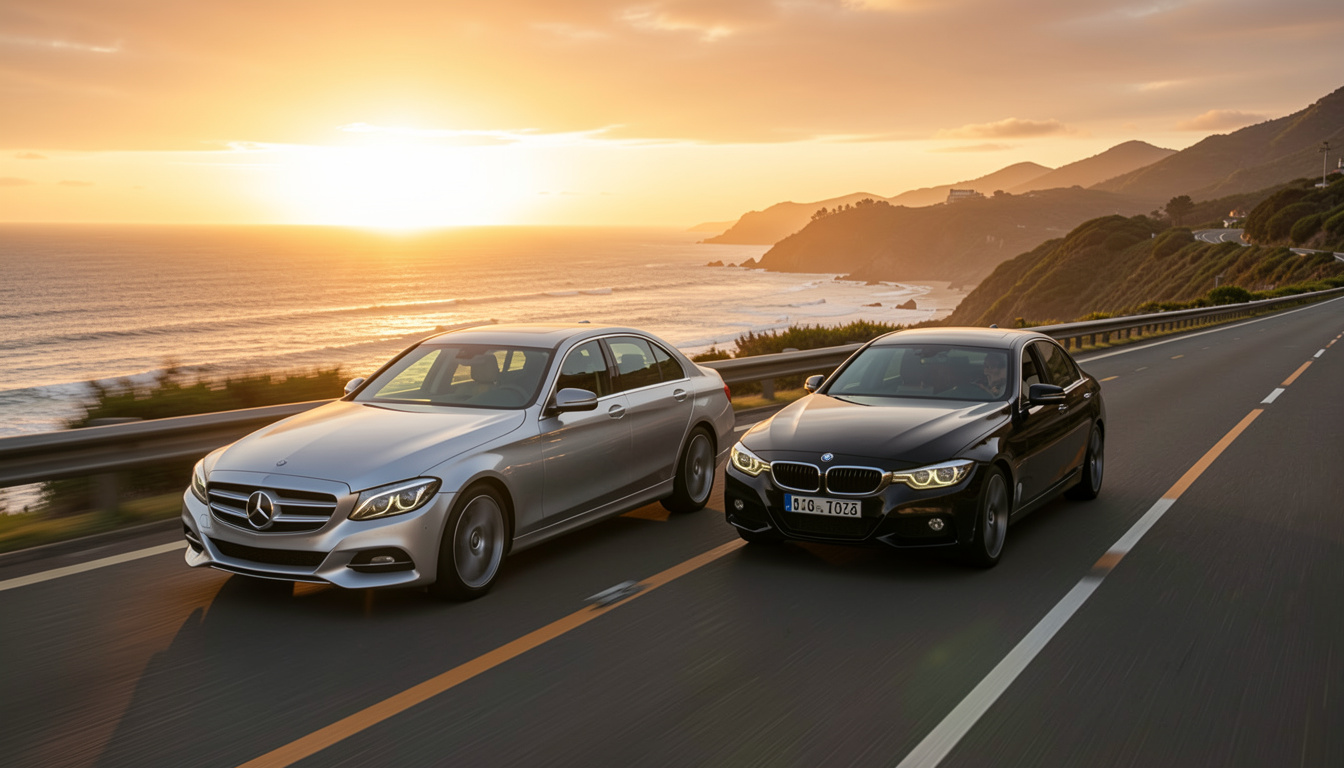
Choosing a compact luxury car can feel like picking between two amazing desserts. You really cannot go wrong, but one will definitely suit your personal taste better than the other. For decades, two German titans have fought for the crown in this class. Today, we are pinning the smooth mercedes c300 vs bmw 330i to see which one deserves a spot in your driveway. Both of these entry-level luxury vehicles offer incredible styles, peppy engines, and badges that make your neighbors look twice.
When you look at the bmw 330i vs mercedes c300 matchup on paper, they seem like identical twins. They both use small, turbocharged engines. They both offer optional all-wheel drive for snowy states. However, once you sit behind the wheel and hit the gas pedal, you will instantly feel that they have completely different souls. One wants to cuddle you in a high-tech spa, while the other wants to sprint down twisty backroads. Let us dive deep into this ultimate sedan battle to find your perfect match.
Under the Hood: Engine Specs and Power
When comparing the mercedes benz c300 vs bmw 330i, the mechanical specifications are shockingly close. Both German automakers rely on a 2.0-liter turbocharged four-cylinder engine. In recent model years, both cars generate exactly 255 horsepower and 295 pound-feet of torque. This is plenty of muscle for merging onto fast highways or passing slow moving trucks.
The major difference lies in how they send that power to the wheels. Mercedes uses a smooth nine-speed automatic transmission. On the other side, BMW uses a lightning-fast eight-speed sport automatic transmission. The Mercedes setup prioritizes silky transitions so you barely feel the gears changing. Meanwhile, the BMW setup snaps into the next gear instantly, keeping the engine right in its sweet spot.
Real-World Performance and Acceleration
If you love the thrill of acceleration, the numbers tell an interesting story. Even though they have the same power ratings, the 2023 bmw 330i vs mercedes c300 sprint times favor the enthusiast. The BMW 330i can zip from zero to 60 miles per hour in just 5.6 seconds. The Mercedes C300 takes a flat 6.0 seconds to complete the exact same run.
Why is the BMW faster? It mostly comes down to weight. The 3 Series is slightly lighter than the C-Class. It also features a near-perfect front-to-back weight distribution. This engineering trick gives the BMW amazing balance when you launch it from a dead stop. If you want a car that reacts the very second your foot hits the floor, the 330i takes the trophy here.
Handling and Driving Dynamics
Driving the BMW 330i feels like holding a sports tool. The steering is heavy, precise, and tells your hands exactly what the tires are doing on the pavement. When you take a sharp corner, the body stays incredibly flat. It gives you a massive burst of confidence, turning mundane morning commutes into a fun game.
The Mercedes C300 takes a much more relaxed approach to the road. The steering wheel feels light and easy to spin with one hand while parking. Instead of carving up corners, the C300 prefers to glide over bumps. Its suspension is tuned to absorb potholes, cracks, and rough highway expansion joints. It feels like riding on a miniature cloud rather than a stiff sports car.
Interior Design: Tech Oasis vs. Driver Cockpit
Step inside the cabin, and the design philosophies move in completely different directions. The Mercedes interior looks like a spaceship inspired by their top-tier luxury models. A giant, vertically oriented touchscreen flows from the center dashboard right down to the armrest. It looks beautiful, especially at night when the customizable 64-color LED ambient lighting glows softly around the vents.
The BMW layout focuses entirely on the person in the driver seat. It features a massive, single piece of curved glass that combines the driver gauges and the center screen. While it looks very modern, BMW luckily keeps a few physical controls intact. The dashboard materials feel solid, durable, and clean, leaning heavily toward a athletic, minimalist look rather than flashy luxury.
Daily Comfort and Seating Space
Long road trips require comfortable seats, and both cars offer great support with unique textures. Mercedes uses a specialized synthetic leather called MB-Tex, which is soft and heavily cushioned. The front seats feel like cozy armchairs. Plus, the C-Class offers slightly more rear legroom, meaning your friends will feel less cramped in the back seat.
The BMW uses its own faux-leather material called SensaTec. These seats are notably firmer than the ones in the Mercedes. They feature large side bolsters that hold your body tightly in place during fast turns. It is great for spirited driving, but drivers who prefer a soft, plush cushion might find the BMW cabin a bit stiff during multi-hour highway stints.
Practicality and Cargo Storage
You might expect these sedans to hold the same amount of luggage since they look similar on the outside. However, the trunk space comparison brings a shocking surprise. The BMW 330i boasts a massive 16.9 cubic feet of cargo room. That is large enough to carry several massive suitcases or an entire family grocery haul with ease.
The Mercedes C300 struggles significantly in this category. It only offers 12.6 cubic feet of trunk space. Even though the C-Class is physically a tiny bit longer on the outside, its internal packaging is less efficient. If you regularly carry golf clubs, strollers, or bulky boxes, the extra room in the BMW makes it a much better daily partner.
Fuel Economy and Efficiency Comparison
With gas prices constantly shifting, fuel efficiency is a massive factor for buyers. Despite its sporty nature, the BMW 330i is incredibly efficient. The rear-wheel-drive version achieves an EPA-rated 31 miles per hour combined city and highway. It manages to save gas by using smart engine management and a lighter body shell.
The Mercedes C300 drops slightly behind, averaging around 29 miles per hour combined. The C300 uses a mild-hybrid electrical system to help smooth out the automatic engine stop-start feature at red lights. While this system makes city driving incredibly quiet and seamless, it adds weight that hurts the overall highway fuel economy numbers slightly.
Looking Back: The Evolution (2019–2022)
To find the best value, many shoppers look at lightly used models. Let us break down how these model years compare if you are browsing the pre-owned market:
- 2019 bmw 330i vs mercedes c300: This year marked the debut of the current “G20” generation 3 Series. It brought a massive leap in tech and reliability, easily beating the older interior design of the 2019 Mercedes.
- 2020 bmw 330i vs mercedes c300: Both models remained mostly unchanged this year. The BMW continued to dominate performance reviews, while Mercedes won over buyers who wanted a traditional, soft luxury ride.
- 2021 bmw 330i vs mercedes c300: Mercedes added more standard safety features this year, but the car was nearing the end of its life cycle, making it look a bit dated next to the fresh BMW.
- 2022 bmw 330i vs mercedes c300: A massive year! Mercedes launched a completely redesigned C-Class (the W206). This gave it a giant high-tech advantage over the 2022 BMW just before the 3 Series got its own screen updates.
Total Cost of Ownership and Maintenance
Buying the car is only the first step; you also have to keep it running. BMW holds a massive secret weapon here called “Ultimate Care.” For the first three years or 36,000 miles, BMW covers all your scheduled oil changes, fluid flushes, and basic inspections for zero dollars. This saves you a lot of pocket change early on.
Mercedes-Benz does not include free factory maintenance. You have to pay out of pocket for their alternating “Service A” and “Service B” visits, which can easily cost hundreds of dollars each year. When you add up the higher lease costs, maintenance fees, and slightly lower fuel economy, running a C300 can cost thousands more over a few years.
Final Verdict: Which Sedan Should You Buy?
Ultimately, the choice between these two incredible machines depends entirely on what makes you smile while driving. The Mercedes C300 is an rolling fashion statement. It is the perfect choice if you want to unwind after a long day at work, enjoy a quiet cabin, and play with gorgeous touchscreen technology.
The BMW 330i is the objective value and performance winner. It is cheaper to maintain, burns less fuel, holds more luggage, and accelerates faster. If you love the act of driving and want a car that feels alive in your hands, the 330i remains the undisputed king of the sports sedan world.
Frequently Asked Questions
Which car is faster from 0 to 60 mph?
The BMW 330i is faster. It reaches 60 miles per hour in 5.6 seconds, while the Mercedes C300 takes 6.0 seconds.
Does the BMW 330i require premium gas?
Yes, both the BMW 330i and the Mercedes C300 require premium unleaded fuel to keep their turbocharged engines running safely.
Which sedan has more trunk space?
The BMW 330i wins easily with 16.9 cubic feet of trunk space, compared to just 12.6 cubic feet in the Mercedes C300.
Is maintenance free on either car?
BMW includes free scheduled maintenance for the first 3 years or 36,000 miles. Mercedes does not offer free standard maintenance.
Which car is better for driving in snow?
Both cars offer excellent all-wheel-drive systems (BMW xDrive and Mercedes 4MATIC) that handle snow easily when paired with good winter tires.
What is the main interior difference?
The Mercedes features a luxury style with a big vertical screen and bright ambient lights. The BMW uses a sleek, driver-focused horizontal curved display.